Entry objective versus native exit
Keep raw causal boundary-recovery ranking separate from the predeclared exit and subsequent financial validation.
A descriptive endpoint is not an entry objective replacement
The path lens reports distance quantities for entered observations. Those fixtures do not train or rank actual entries. Genuine entry models are ranked on the raw causal boundary-recovery objective under the authoritative policy, not a retrospectively selected exit-adjusted return. Freeze the entry identity before applying the experiment's chosen exit. A favorable terminal path label alone cannot reveal how candidates were selected. Preserve objective, allowed inputs, candidate history and access to outcomes so a later financial explanation does not rewrite the earlier ranking basis.
One exit has predeclared ownership
An experiment's single selected exit must remain identifiable before reserved evidence is consulted. Profit factor, win rate, holding drift and other financial outcomes can validate, reject, size or measure overlap without choosing a new entry ranking. Do not reopen an exit tournament after seeing evaluation or forward results. A reference touch can be studied as a descriptive event while an actual strategy exits under another native policy. The tool supplies no fills or orders and must not assume the most favorable path price is an executable exit.
Native minute and risk rules remain intact
Where APEX policy applies, use the verified minute execution policy and persisted row ownership. Completed sessions may advance maximum-hold clocks, but must not decide daily stop exits or profit floors. Preserve whole-position exits and native risk and maximum-hold requirements unless the owner explicitly changes them. Research fill convention likewise remains the best hypothetical fill within its established frozen directional observation window. Do not silently switch to first-available or extend the window. These real policies cannot be inferred from the education site's anonymous positive-close horizon.
Financial completion and release are still separate
A full real instrument request goes through the authoritative factory and independently verified master, including missing asset-class integration when necessary. A software count, adapter preparation or compact candidate grid is not that end state. A verified no-model master can be valid completion, while unavailable data or unimplemented master cannot. Production promotion then needs actual cloud artifact, subscriber route and certification and is separately authorized. The site's static deployment publishes educational contracts only, with no actual model fitting, financial validation or live exit-policy change.
Authored reference and excursion case
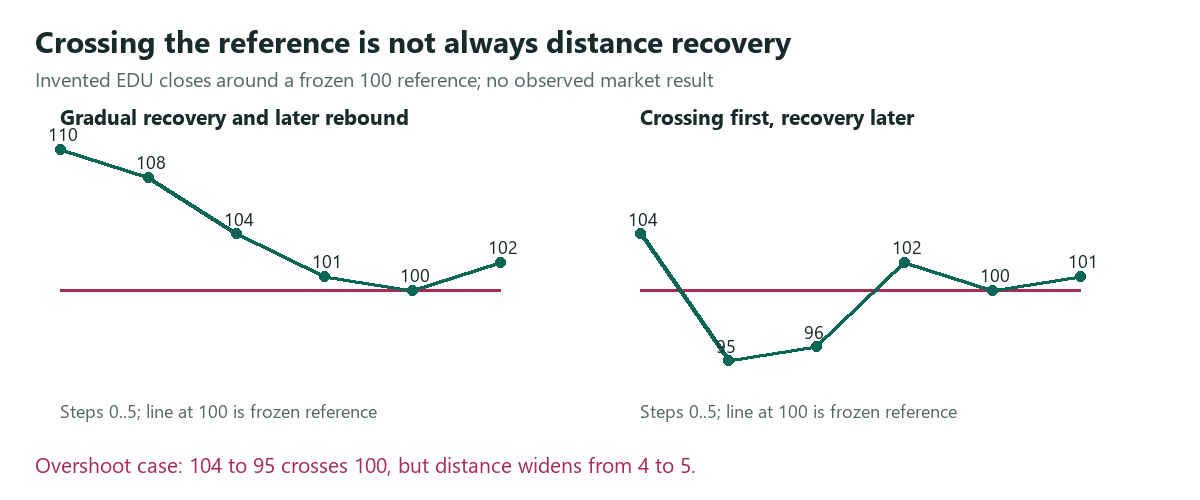
The authored gradual path reaches reference 100 at step four and ends at 102 at step five. Those are two different descriptive observations, not two candidate exits entered into a real competition. A genuine experiment would identify its one native exit beforehand and retain its permitted execution and accounting. Selecting whichever point looks best after viewing the path would change the policy. No actual broker fill or winning strategy is supplied by the example.
| Object | Record | Bounded finding |
|---|---|---|
| Step 4 | Reference touched | Descriptive event |
| Step 5 | Terminal 102 | Different observation |
| Actual exit | Predeclared native policy | Absent from fixture |
| Entry ranking | Raw causal objective | Not reconstructed from favorable price |
Primary references and scope
Source review: 14 October 2026. Official mechanism descriptions are not this desk's paid-account test, independently captured fills or vendor-return audit.