First passage and horizon censoring
Distinguish observed hits, complete-horizon non-hits and missing future data without estimating unprovided recovery probabilities.
Name the first matching observation
First passage asks when a path first satisfies a specified boundary condition. Strictly closer, within an inclusive band and touch/cross have different operators, so they can have different first observations. The new lens reports one-based future steps, with step zero when the initial observation is already in-band or at-reference. These are supplied-path diagnostics, not estimated passage distributions. A first hit does not tell how long the process stays there or which action a financial strategy takes. Preserve the endpoint and observation ownership before interpreting a reported timing number.
A complete non-hit differs from missing data
If a declared five-observation horizon has five valid closes and no hit, report no matching observation within that horizon. That is bounded evidence, not proof the process will never recover. If only three closes exist, the five-observation question is incomplete. The tool rejects that input rather than treating unavailable closes as failures or inventing values. A real study must preserve missingness, data arrival and label maturation. These can have different causes and consequences from an observed non-hit. Excluding unfinished events selectively can distort the visible population even when completed paths are calculated correctly.
Later values cannot extend the favorable window
The bounded case supplies eight future closes but inspects only three. A hit at the fourth declared close belongs outside that horizon. All later declarations remain visible in the complete ledger and are counted as unused. They do not influence the inspected terminal, best, worst or first-hit metrics. A researcher may declare a different horizon for a separate experiment, but should retain the selection history. Replacing the unsuccessful window with a longer successful one after seeing prices consumes evidence. It is not untouched confirmation of the original event rule.
Inference needs the population and dependence design
Seven authored paths cannot estimate a genuine first-passage probability or survival curve. Real inference needs complete eligible events, consistent endpoints, source timing and dependence treatment. Repeated adjacent stretches may share the same extended excursion. The tool supplies no confidence interval or effective sample size. Its null hit is an output of the declared finite path, not a calibrated grade. Economic use additionally needs raw causal entry, native exit, fills and full independently required research. Conditional AR expectation half-life remains a different mechanism and cannot supply a passage distribution by relabelling.
Authored reference and excursion case
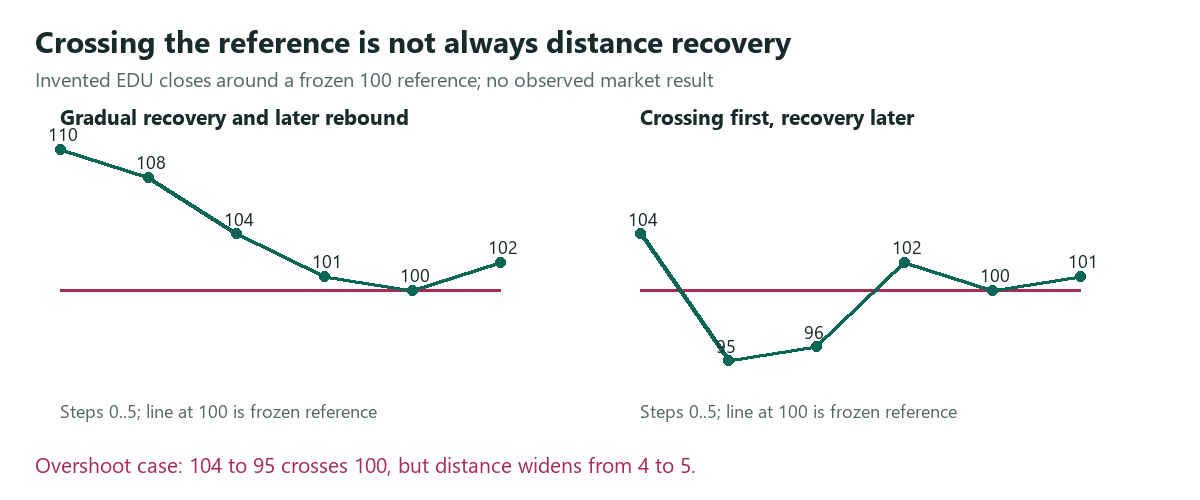
The bounded authored path starts at 110 around reference 100 and supplies 108, 104, 101, 100, 102, 100, 99 and 98. Horizon three sees a band-one hit at step three, but no reference touch/cross. The later exact reference at step four is deliberately unused. All eight declarations remain in the download. The case provides no actual calendar or model probability and does not claim that an event unable to touch within three observations can never recover.
| Object | Record | Bounded finding |
|---|---|---|
| Inspected | Steps 1..3 | Terminal 101; distance 1 |
| Band one | Step 3 at equality | Inclusive hit |
| Reference touch | Declared step 4 | Outside chosen horizon |
| Unused | Five later closes | Preserved, not scored |
Primary references and scope
Source review: 14 October 2026. Official mechanism descriptions are not this desk's paid-account test, independently captured fills or vendor-return audit.