Frozen reference versus moving target
Keep an event destination identifiable when rolling estimates, revisions or equilibrium assumptions change.
The destination owns the label
Reversion requires a named destination, not simply a direction that looks sensible after a chart is complete. A prior-window average, updated rolling mean and fitted equilibrium are different objects. If an event is labelled by distance to the reference known at its start, retain that scalar throughout its outcome window. A later reference approaching an unchanged price can create apparent recovery under another definition. That may be a legitimate hypothesis when declared beforehand, but it does not answer the original frozen question. Store reference rule, value, source version and effective observation clock beside each event.
A later estimate cannot repair the old question
Reference updates may use observations unavailable at the original decision. A current rolling display can therefore be different from the destination that an earlier event owned. Preserve both versions rather than silently rewriting the historical label. The changed-equilibrium teaching card demonstrates this without claiming a real statistical break. Genuine source causality needs original availability and allowed revision policy. A file's latest date or a chart's current annotation does not establish the reference that a live system used earlier. A model nickname also cannot resolve that identity gap.
The frozen path lens has a narrower lane
The new tool accepts one positive reference and positive supplied closes. It does not fit an average, estimate an equilibrium or update the destination. Its initial and future steps are observation indices, not market timestamps. Best, worst and terminal distances all use the same input reference. This deliberate simplicity makes endpoint ownership inspectable. It does not validate the input source or prove that a real model had access to that reference. The original price lab separately constructs a prior-window mean using its declared convention, without turning that descriptive procedure into independent economic research.
A material revision needs its own evidence
If the real process or reference rule changes, identify a successor and determine which previous sources remain compatible. Old outcome statistics do not automatically validate the new system. Preserve the raw causal entry objective, frozen candidate and one predeclared native exit when conducting actual research. A later favorable financial result cannot retroactively authorize the changed destination. The website's cards are fully written but contain no authentic model source or independent master. They can help formulate a request without manufacturing the artifacts needed to answer it.
Authored reference and excursion case
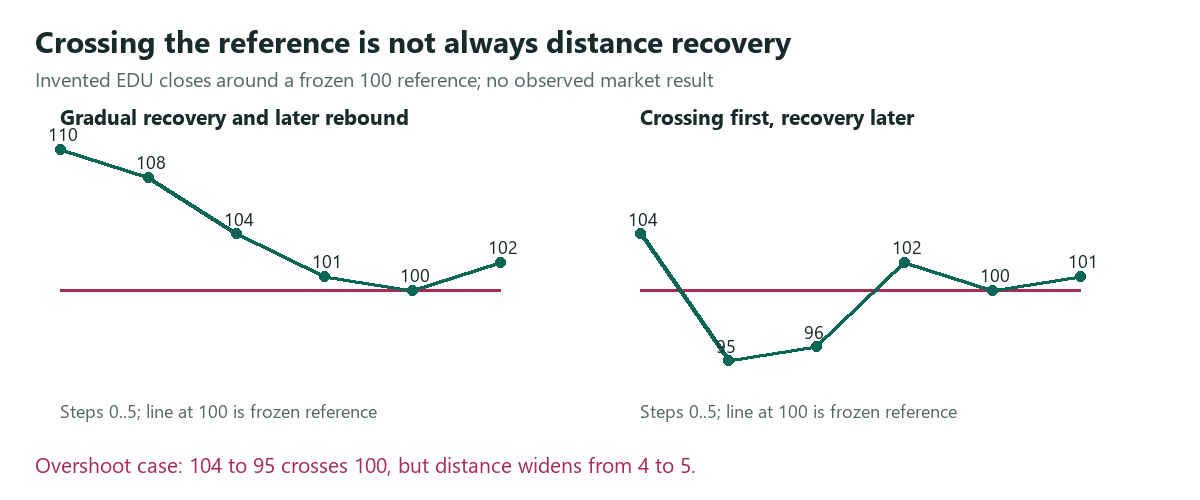
In an authored event, initial price is 110 and the known frozen reference is 100. A later close of 108 is distance eight from that reference. If a later rolling estimate also becomes 108, a moving-target calculation reports distance zero. The price path did not suddenly provide the original frozen recovery. The two calculations answer different questions. Neither is a genuine market event, and the example does not diagnose a real model or source revision.
| Object | Record | Bounded finding |
|---|---|---|
| Original | Reference 100 / price 110 | Initial distance 10 |
| Later frozen view | Reference 100 / close 108 | Distance 8 |
| Later moving view | New reference 108 / close 108 | Different label: distance 0 |
Primary references and scope
Source review: 14 October 2026. Official mechanism descriptions are not this desk's paid-account test, independently captured fills or vendor-return audit.