Price-level, return and spread hypotheses
Identify the process being studied before applying an equilibrium, stationarity test or reversion label.
Process transformation changes the question
A price level, its return and a fitted two-leg residual represent different statistical objects. A price moving toward a prior average does not automatically imply negative return autocorrelation. A residual around a fitted equilibrium also has leg and parameter identity absent from a one-price series. Name the process and transformation before applying a test or recovery rule. A familiar chart label cannot resolve this distinction. The positive-price lens intentionally accepts only positive scalar prices and reference, not a signed spread or negative-price instrument that its input contract cannot represent.
A reference needs the matching process
A prior mean of prices supplies one descriptive destination. A return process may concern a different center and scale, while a spread equilibrium depends on actual legs, ratio and fitting scope. Reference revisions and source adjustments can affect each differently. Preserve the exact units and operator. Do not compare distance percentages across incompatible objects and call one the better financial model. The teaching spread card leaves actual values and hedge ratio absent rather than simulating them through a positive-price shortcut. A genuine pair requires its lawful causal data and asset route.
Test specifications do not transfer automatically
ADF and KPSS have distinct hypotheses and options that must match the selected process. An inference about one transformation does not simply certify another. Deterministic terms, lag treatment and sample version remain part of the record. The new tool fits neither test and cannot establish stationarity by following seven invented paths. A future real study should pin its statistical method before reading results and preserve rejected specifications. Documentation explains mechanisms; it does not give this publication independent financial evidence about an unobserved proprietary model.
Economic actions need more than a process label
A statistically framed hypothesis still requires raw causal entry identity, a predeclared native exit, quantities and complete accounting. A two-leg action adds synchronization, financing or borrow considerations where applicable and actual fills for each leg. Changing the process after an unfavorable evaluation consumes selection evidence. Keep the full authoritative factory and master requirements rather than substituting a transformation diagnostic. An actual live claim adds deployed cloud identity, subscriber route and certification. The site's process map clarifies these missing objects without inventing a trained strategy or a marketed success rate.
Authored reference and excursion case
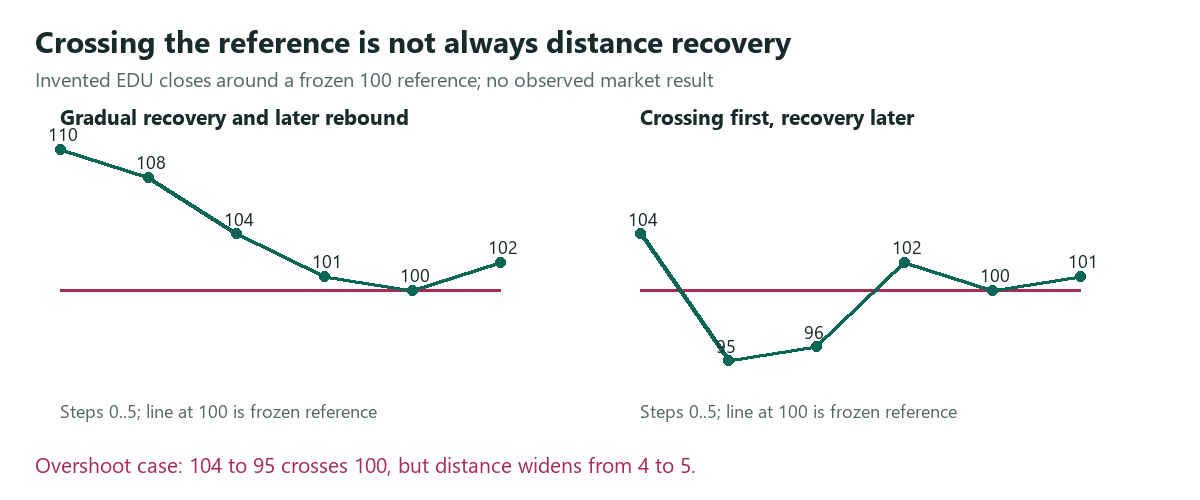
An authored note calls a price's next close closer to its prior mean. Another note calls return autocorrelation negative, while a third proposes a spread residual. They cannot share one unexplained recovery rate because their objects and labels differ. No actual series is supplied to test any hypothesis. The exercise names the source, transformation and parameter records a genuine comparison would require, rather than announcing that one process has been proven best for trading.
| Object | Record | Bounded finding |
|---|---|---|
| Price level | Prior-price destination | One scalar reference |
| Return | Return transformation | Different center and label |
| Spread | Actual legs and ratio | Separate fitted identity |
| Account | Execution and weights | Not a statistical score |
Primary references and scope
Source review: 14 October 2026. Official mechanism descriptions are not this desk's paid-account test, independently captured fills or vendor-return audit.