AR(1) expectation half-life worksheet
Convert an assumed positive decay coefficient into observation intervals and minutes. No model fitting or price forecast.
Educational diagnostics, not a signal service. A standardized price displacement is not a calibrated probability; invented examples and user-supplied observations are not verified market performance.
The exact calculation
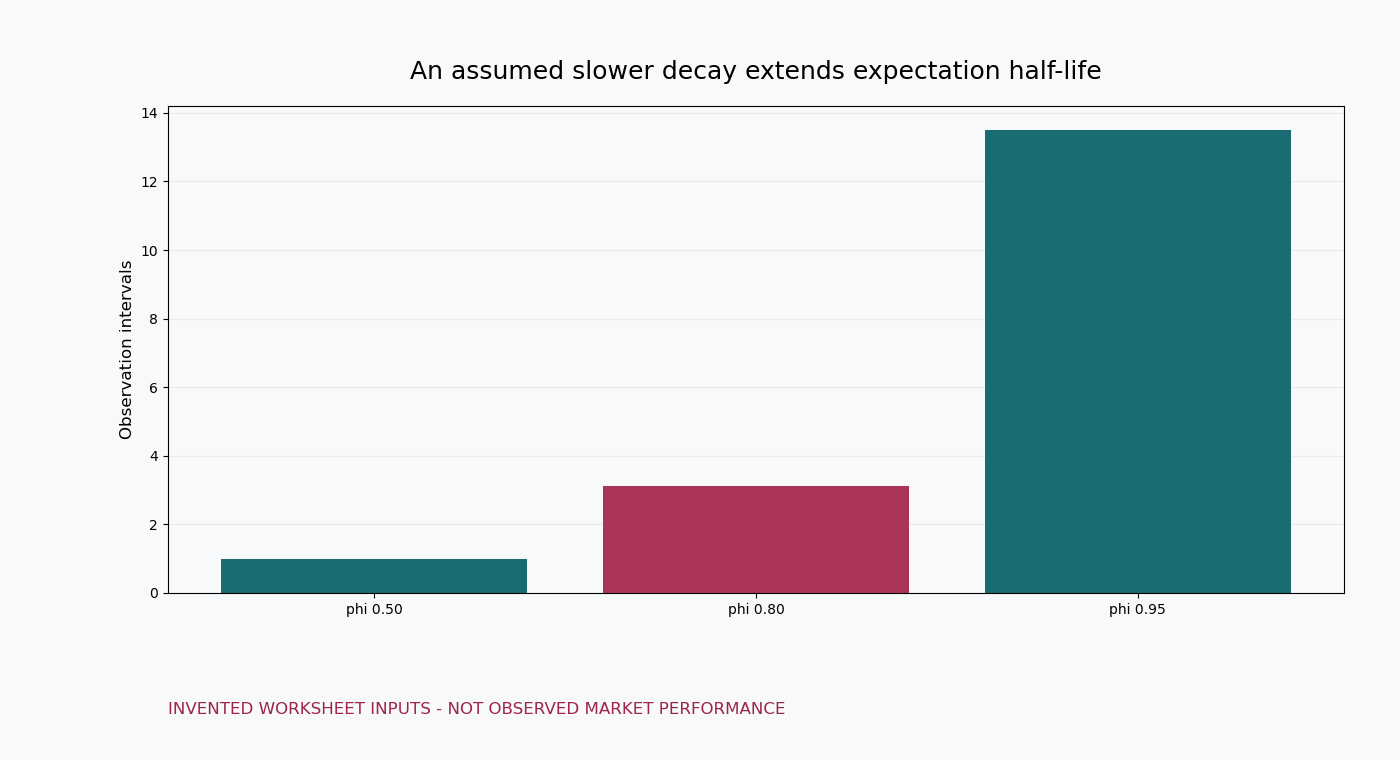
For 0 < phi < 1, conditional displacement after k intervals is phi to the power k times the initial displacement. Solve phi to the power h = 0.5: h = ln(0.5) / ln(phi). Multiplying h by the fixed interval gives minutes. Phi 0.8 and 60-minute observations produce approximately 3.1063 intervals, or 186.377 minutes.
What this number leaves out
This is an assumption about conditional expectation around an unchanged equilibrium. It is not the median first-passage time, a probability of reaching the mean, a guarantee of recovery or a risk-management deadline. Innovations, coefficient estimation, changing equilibrium, irregular observations, spreads and execution are absent. This tool rejects non-positive phi and phi at or above one rather than applying an inappropriate interpretation.
A useful sensitivity exercise
Hold the observation interval fixed and compare phi 0.5, 0.8 and 0.95. Record the coefficient specification and uncertainty separately; the worksheet has not estimated either. A fit to a particular sample requires its own frozen training data, diagnostics and reserved evaluation. Export includes the assumed inputs, arithmetic results and limitations.
Source documents
- statsmodels autoregression documentation
- Augmented Dickey-Fuller test documentation
- SciPy statistical reference
Documentation establishes the stated mechanism, not tested trading performance. Checked 9 October 2026; a later version can differ.
Expectation decay cannot predict the first observed hit
A stable positive coefficient specifies conditional mean decay under an unchanged equilibrium assumption. Innovations and path boundaries make realized first arrival a separate question. The new lens has concrete authored observations and computes first matching indices, but estimates no distribution connecting those indices to the assumed coefficient. Its band is an entered absolute tolerance, not a fitted probability interval. Keep the worksheet result in observation intervals and only multiply by a declared fixed duration within its own conditional arithmetic lane.
Do not train entries on a chosen convenient exit
A real experiment ranks entries on its raw causal objective and freezes identity before applying the selected native exit. An expectation half-life cannot be retrospectively chosen as a winning stop after examining reserved outcomes. A later changed equilibrium or coefficient requires its own source and selection scope. The worksheet does not fit a model, initiate an instrument factory task or issue a live risk policy. Its input validation and original JSON export remain intact alongside the new path diagnostics.