Observation time versus calendar time
Avoid translating row counts into elapsed duration without an identified venue, source and availability clock.
A row needs a time interpretation
An observation can represent a completed bar, trade event, session close or irregular update. Five rows need not mean five minutes, five days or five exchange sessions. The new lens uses anonymous one-based observation steps only. Its horizon remains that count rather than a calendar deadline. The original AR worksheet multiplies a fractional expectation half-life by an explicitly entered fixed interval; this is a conditional arithmetic convention, not a reconstructed irregular calendar. State which clock each quantity uses before comparing them or treating one as a native holding rule.
Missing observations must stay identifiable
A real series can omit expected bars or arrive late. Removing a blank and counting the following row as the next fixed interval can change both features and target horizon. Preserve expected calendar, available observations and source revision separately. The positive-path parser rejects empty interior lines rather than silently compressing them. A valid list still does not authenticate its calendar or source availability. User-supplied values and authored presets remain unverified. In genuine research, a missing future label is different from a complete interval with no event, and their treatment must be frozen.
Availability and event clocks are not interchangeable
The event timestamp may precede the source version's arrival. A later correction can have the same event date while becoming usable only afterward. A causal reference needs the values permitted at the actual decision, not the latest revised history. Label resolution uses future observations under its separate contract. Order request and fill clocks concern yet another receiving process. None can be inferred from a CSV line number. A genuine study should trace one observation through source, feature, decision and label completion before presenting a timing statistic as operational evidence.
Native exit clocks retain their owners
Real risk and maximum-holding rules belong to the actual model and execution policy. A completed-session routine may update a holding count without deciding daily stops. The website adds no APEX daily stop management or substituted baseline. Keep minute execution, whole-position exits and maximum hold where those policies apply. An educational horizon is not a production scheduler and grants no execution permission. Research fill conventions likewise remain frozen under their established observation window. Actual instrument research needs its full authoritative route and independent master, not a calendar guessed from a scalar fixture.
Authored reference and excursion case
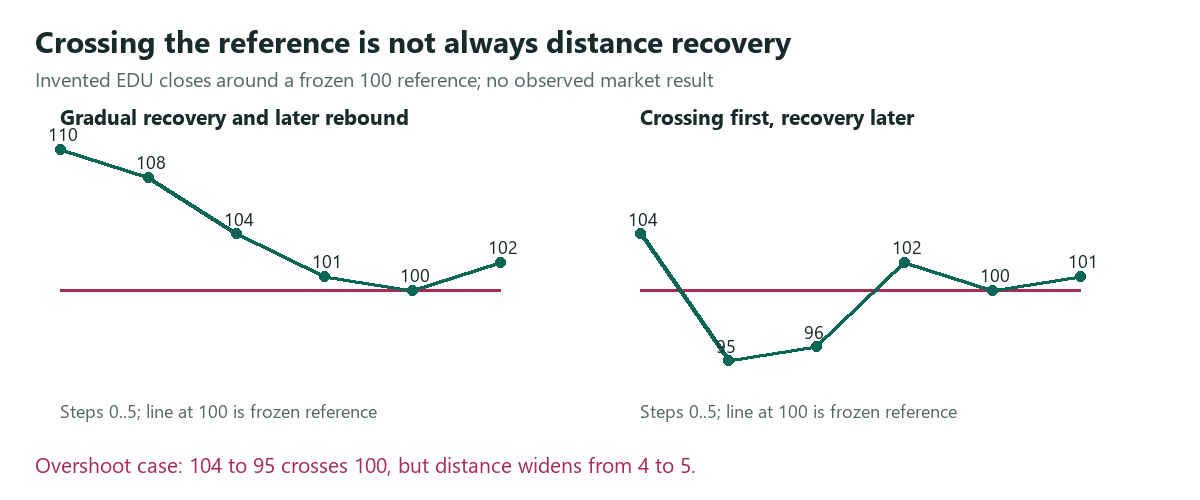
An authored list labels its next observations steps one, two and three but intentionally gives no timestamps. A five-observation endpoint cannot be described as five minutes. In a different hypothetical source, the next available row might follow an omitted interval; line order would not repair the missing calendar. The example does not claim a real data-feed outage or measured vendor delay. Its useful result is the precise request for expected calendar, availability and label-resolution records.
| Object | Record | Bounded finding |
|---|---|---|
| Observation index | Anonymous steps | No elapsed duration |
| Expected calendar | Actual source needed | Missingness has identity |
| Availability | Original permitted version | Not inferred from event date |
| Exit clock | Native policy | No worksheet override |
Primary references and scope
Source review: 14 October 2026. Official mechanism descriptions are not this desk's paid-account test, independently captured fills or vendor-return audit.