Overshoot: crossing versus distance recovery
Trace the original-side crossing rule separately from strict absolute-distance improvement and terminal outcome.
Directed movement can overshoot the destination
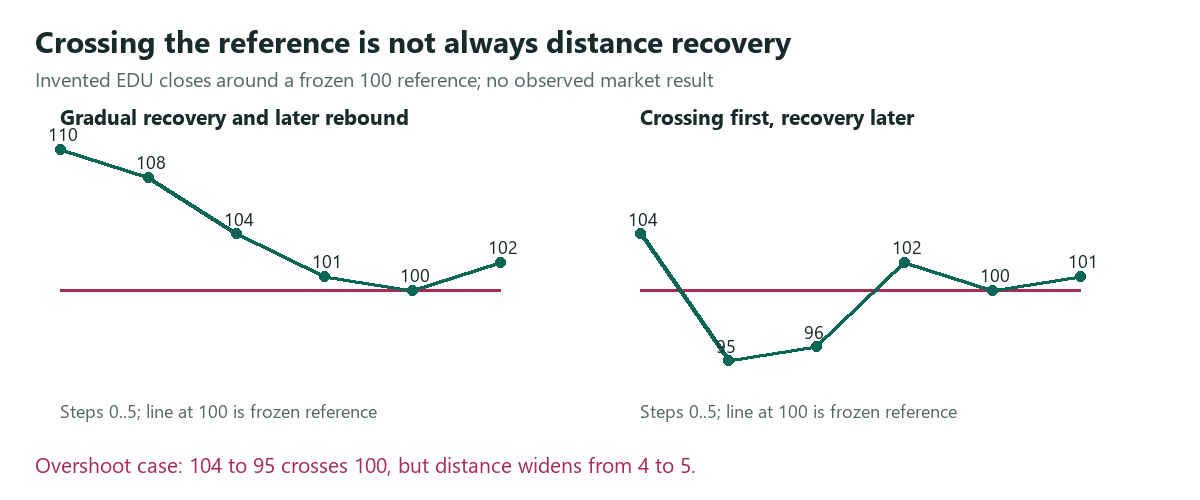
An initially above-reference price can fall through the reference and end farther away on the other side. A directionally appropriate move does not guarantee absolute-distance recovery. Preserve the destination and initial distance when defining a closer label. Crossing is a separate event concerning original side. If a study wants that event, state it rather than swapping labels after an attractive price move. The original price lab already distinguishes directed next movement from strictly closer next distance. The expanded workbook follows those separate endpoints across multiple observations without converting either into a financial win.
Equality matters to both definitions
Strict closeness uses a smaller absolute distance, so equal distance fails even if the reference has been crossed. An inclusive absolute band accepts equality at its boundary. Touch/cross includes exact reference equality and uses the initial side throughout the inspected path. A start already at reference has step-zero touch, with later flags denoting exact touches because no initial directional side exists. These edge cases should remain explicit in exports and fixtures. Silently using less-than in one place and less-than-or-equal elsewhere can change the event population and interpretation.
First success does not determine the terminal label
The default path approaches, reaches a band, touches the reference and later rebounds. Its first-hit and terminal metrics therefore describe different times. A chosen native trading exit might use a specific event, but the lens has no order or exit policy. It cannot assume a fill at the most favorable observation. A full path makes these distinctions visible while retaining adverse observations. A chart showing only the hit would conceal the later reversal. Real research must preserve its established entry reference and best hypothetical fill window rather than silently extending or replacing those policies.
Distance quantities are not account quantities
Maximum distance extension includes the initial observation and measures only how far the declared path moves from its fixed destination beyond its initial distance. It is not account drawdown or a risk multiple. Terminal recovery divides a distance difference by initial distance, not capital. Costs, spreads, quantities and native exits are absent. Its sign and magnitude cannot rank a provider's profitability. The seven cases are authored, so they do not even establish observed market frequency. Independent financial evaluation still needs its own canonical process and actual accounting evidence.
Authored reference and excursion case
The invented overshoot case begins at 104 with reference 100. At step one, 95 crosses and widens distance from four to five. Step two at 96 has equal distance and is not closer. Step three at 102 is first strict closeness. Step four at 100 is first band-one arrival because the prior prices were outside it. Terminal 101 leaves distance one and a 75% distance recovery. That percentage is not an account return.
| Object | Record | Bounded finding |
|---|---|---|
| Step 1 | 95 / distance 5 | Crossed but farther |
| Step 2 | 96 / distance 4 | Equal is not closer |
| Step 3 | 102 / distance 2 | First strict closeness |
| Step 4 | 100 / distance 0 | First inclusive-band hit |
Primary references and scope
Source review: 14 October 2026. Official mechanism descriptions are not this desk's paid-account test, independently captured fills or vendor-return audit.